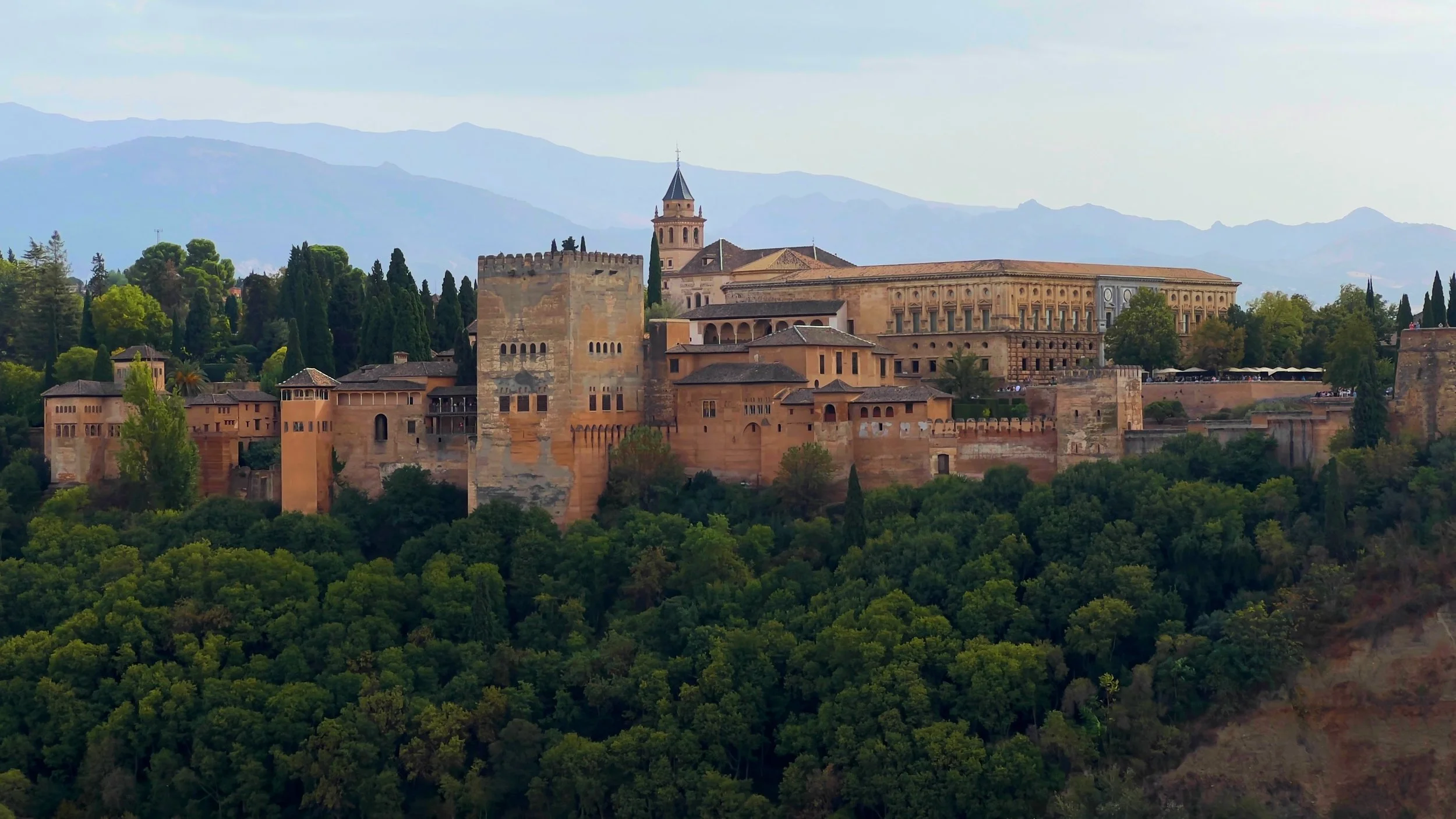
There are certain places in Europe that seem almost larger than history itself. Places where the architecture, landscape, and stories of the people who lived there come together so completely that simply walking through them can help you understand a destination in a different way.
The Alhambra in Granada, Spain, is one of those places.
Rising above the city on a wooded hill, the Alhambra is one of Spain's most recognizable historic landmarks. Its name is often connected with the Arabic description of a “red castle” or “red fortress,” and its walls, towers, courtyards, palaces, and gardens reflect centuries of Islamic and Christian history.
The Alhambra and nearby Generalife were designated a UNESCO World Heritage Site in 1984, with Granada's Albayzín neighborhood later added to the designation. But titles and designations only tell part of the story. What makes the Alhambra so memorable is the experience of moving through a place where history continues to reveal itself one room, courtyard, and garden at a time.
A Palace City From the Nasrid Era
One of the first things to understand about the Alhambra is that it is not a single palace.
It is an extensive complex of fortified walls, towers, courtyards, residences, gardens, and other structures overlooking Granada. Earlier fortifications existed on the hill, but much of the Alhambra as we know it today began taking shape during the 13th century under the Nasrid dynasty, the last Muslim dynasty to rule in the Iberian Peninsula.
Over time, the site developed into a royal palace city as well as a defensive stronghold. Rulers, members of the royal household, officials, guards, servants, and others lived and worked within its walls.
That helps explain why visiting the Alhambra feels so different from walking through a single castle or palace. You are moving through an entire historic environment rather than simply touring one grand building.
Beauty Revealed in the Details
The Alhambra does not rely on one enormous façade or single dramatic room to make an impression. Much of its beauty is discovered gradually.
Intricate plasterwork covers walls and arches. Geometric patterns repeat across tiles and decorative surfaces. Arabic calligraphy becomes part of the architecture itself. Courtyards use light, water, and carefully balanced proportions to create spaces that can feel remarkably peaceful despite the complexity of their decoration.
The closer you look, the more there is to notice.
A carved archway may lead into another courtyard. Sunlight may reflect across a long pool and change the appearance of the surrounding walls. Ceilings contain patterns so detailed that it is difficult to imagine the time and craftsmanship required to create them.
Rather than simply looking at the Alhambra from a distance, much of the experience comes from slowing down enough to notice these smaller details.
The Generalife: More Than Beautiful Gardens
The Generalife provides another side of the experience.
Located beside the Alhambra complex, the Generalife served as a country estate and retreat for the Nasrid rulers. Its gardens, courtyards, fountains, pools, and shaded walkways were designed as places of rest away from the more formal demands of palace life.
Water is an important part of the atmosphere. It flows through channels and fountains, reflects surrounding architecture, and adds sound and movement to the gardens. Combined with flowers, greenery, and views toward Granada and the Alhambra, it creates a noticeably different feeling from the fortified areas nearby.
It is easy to understand why the Nasrid rulers would have valued this setting as a retreat. Even centuries later, the gardens still encourage visitors to slow their pace and pay attention to their surroundings.
Where Islamic and Christian History Meet
The story of the Alhambra did not end with the Nasrid dynasty.
In 1492, Granada came under Christian rule following its surrender to Ferdinand and Isabella. The Alhambra was then adapted and altered by Spain's Christian monarchs, adding another layer to an already complicated history.
One of the most visible later additions is the Palace of Charles V, a Renaissance building that looks strikingly different from the Nasrid architecture surrounding it.
That contrast is part of what makes the Alhambra so historically interesting. It is not a place representing only one period of Spanish history. The site shows how different rulers, religions, artistic traditions, and political eras overlapped and changed Granada over centuries.
Rather than seeing Islamic history and Christian history as completely separate stories, the Alhambra allows you to see where those histories meet.
Why the Alhambra Is a UNESCO World Heritage Site
The Alhambra and Generalife were added to UNESCO's World Heritage List because of their exceptional cultural and architectural significance. Granada's historic Albayzín district was later included as part of the same World Heritage designation.
Together, these areas help tell the story of medieval Granada and the cultural influences that shaped the city.
For a traveler, though, UNESCO recognition is only part of what makes the site important. The real value comes from being able to walk through spaces where architecture, gardens, water, art, religion, and political history are all connected.
The Alhambra is not simply beautiful. It helps explain an important chapter of Spain's past.
Why Seeing the Alhambra in Person Is Different
Photographs can show you the Alhambra's famous courtyards, decorative walls, arches, and views over Granada. What they cannot fully capture is how the spaces connect.
You walk from an enclosed courtyard into an open garden. A narrow passage suddenly reveals a broad view across the city. Elaborately decorated rooms give way to quiet outdoor spaces filled with water and greenery.
That movement is part of the experience.
It is also why having historical context can make such a difference. When you understand who built these spaces, how they were used, and what happened after Granada changed hands in 1492, the Alhambra becomes much more than a collection of beautiful rooms.
You begin to see it as part of a much larger story.
🇪🇸 Experiencing Granada on an Escorted Tour
For travelers exploring southern Spain, Granada is often one of the destinations that stands out long after the vacation is over.
Several escorted Spain itineraries include Granada because it adds something different to the journey. Madrid, Barcelona, Seville, and other Spanish cities each tell their own part of the country's story, while Granada provides a particularly vivid look at the centuries when Islamic and Christian cultures shaped the Iberian Peninsula.
When comparing escorted tours of Spain, I would look beyond whether “Granada” simply appears on the itinerary. Consider how much time is spent there, what sightseeing is included, whether a local guide is part of the experience, and exactly which areas or admissions are part of the tour.
Those details can determine whether Granada is simply another stop—or one of the experiences you remember most.
A Place That Stays With You
What makes the Alhambra remarkable is not only its age, architecture, or famous views. It is the way all of those elements come together.
The fortified walls remind you that this was once a stronghold. The palaces reveal the artistry and sophistication of the Nasrid court. The Generalife gardens show another, quieter side of royal life. Later Christian additions remind you that history did not stop when one era ended and another began.
Centuries of change are visible in the same place.
That is why the Alhambra deserves more than a quick photograph and a checkmark beside its name on an itinerary. It is a place worth understanding.
Some landmarks are memorable because they are beautiful. Others stay with us because of the stories they tell.
The Alhambra is both.
Explore more destination inspiration, travel planning tips, and helpful advice from Escape World Travel.