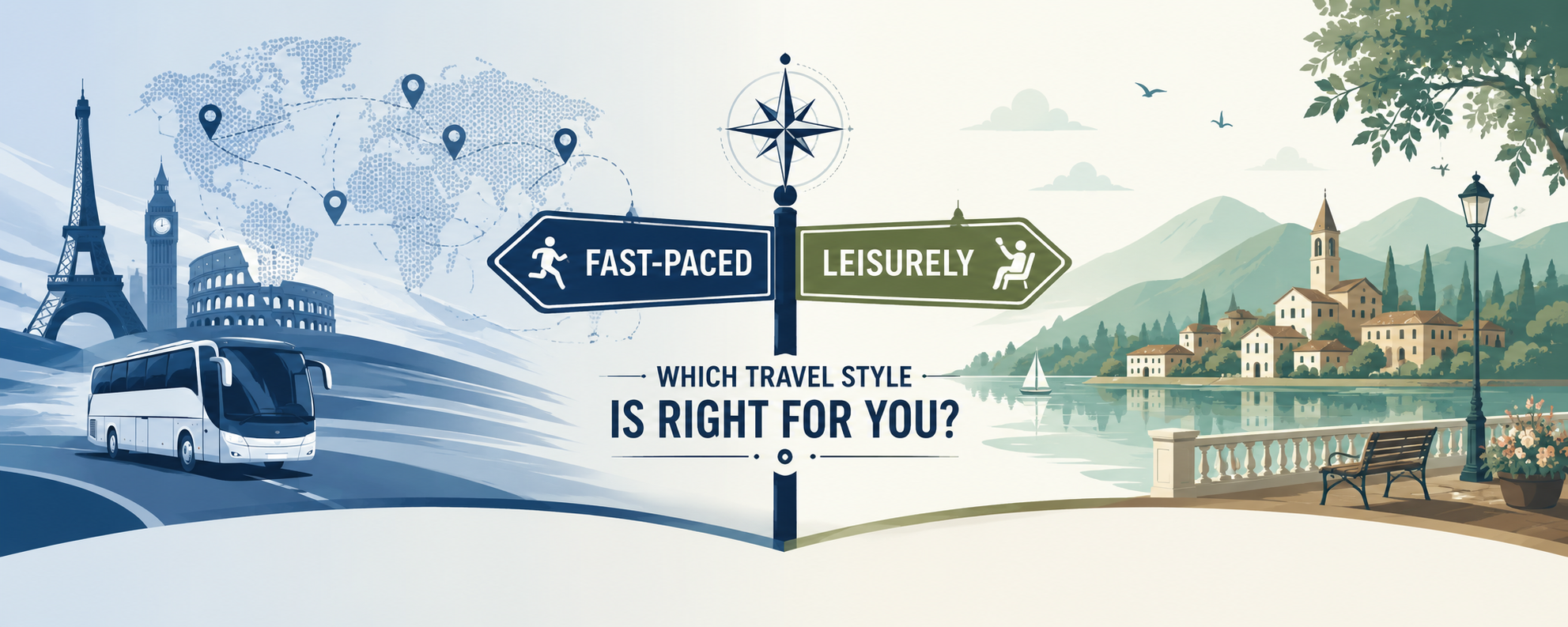
When travelers compare escorted tours, one of the first questions they often ask is whether a tour is fast-paced or leisurely.
It sounds like a simple question, but pace is not determined by the number of countries on an itinerary alone. A tour can visit several destinations and still include meaningful free time, while a geographically focused tour can have very full sightseeing days. Hotel changes, travel time, walking, guided sightseeing, optional excursions, early mornings, and how you choose to spend your independent time all influence how a vacation actually feels.
That is why I would not choose a tour simply because someone described it as “fast” or “slow.”
The better question is: What kind of pace feels comfortable and enjoyable to you?
⏱️ What Makes an Escorted Tour Feel Fast-Paced?
A tour usually begins to feel faster when several things happen at once. You may be changing hotels frequently, traveling longer distances between destinations, beginning sightseeing earlier in the day, visiting several places before reaching the next hotel, or participating in activities that involve significant walking.
None of those things is automatically negative. For a traveler who wants to see as much as possible, a fuller itinerary can be exactly what makes the vacation exciting.
Other travelers prefer more time in the same area. They may enjoy mornings when they do not have to repack a suitcase, afternoons with no scheduled sightseeing, or the freedom to sit at a café without thinking about when they need to meet the group again.
The important thing is recognizing which experience sounds more like your idea of a vacation.
A Broader European Journey: The HEART OF EUROPE® Grand Tour
Image Tours' 22-Day HEART OF EUROPE® Grand Tour is a good example of a vacation designed for someone who wants a broad European experience.
The itinerary travels through the Netherlands, Belgium, Germany, Austria, Italy, Switzerland, France, and England. Along the way, travelers experience destinations such as Amsterdam, Antwerp, the Rhine Valley, Heidelberg, Rothenburg, Munich, Innsbruck, Venice, Verona, Rome, Florence, Pisa, the Swiss Alps, Paris, and London.
That geographic variety is part of the appeal. You are watching the scenery, architecture, food, language, and culture change as you move across Europe rather than concentrating on one smaller region.
But a longer tour does not mean twenty-two straight days of nonstop sightseeing. The itinerary also includes independent meals, periods of free time, and optional excursions. For example, Rome includes time for personal interests, while Paris and other destinations provide opportunities to explore beyond the scheduled sightseeing.
Still, this is a journey covering a substantial amount of Europe. Travelers should be comfortable with moving from region to region, spending time on the motor coach, changing hotels, and balancing sightseeing with travel days.
For someone who says, “I may only do a big European trip once, and I want to experience as much variety as I can,” that broader style of itinerary may be very appealing.
A More Geographically Focused Journey: Germany, Austria & Switzerland
Now compare that with Image Tours' 15-Day Germany, Austria & Switzerland Tour.
This itinerary stays within a much more concentrated part of Europe, with time in Germany, Austria, and Switzerland along with a stop in Vaduz, Liechtenstein. Instead of continuing south into Italy or west toward Paris and London, the journey focuses more deeply on Bavaria, Salzburg, the Austrian Alps, Tyrol, the Swiss Alps, the Black Forest, Heidelberg, and the Rhine region.
That narrower geography allows for several multiple-night stays and some days with meaningful flexibility. In Filzmoos, for example, travelers have a leisure day with the choice of relaxing, hiking, biking, or joining an optional Eagle's Nest excursion. The Tyrolean Village also includes a day when travelers can enjoy the surrounding area, return to Innsbruck independently, or join an optional excursion to Neuschwanstein and Linderhof. Rüdesheim provides another full day with the option of exploring independently or joining an optional Rhine cruise and cable-car excursion.
I would describe this tour as more geographically focused, rather than simply calling it slow.
There is still sightseeing. There are still motor-coach days, hotel changes, walking, and organized activities. But the itinerary also gives travelers opportunities to settle into particular regions and decide how active they want some of their days to be.
For someone who loves alpine scenery, charming towns, Germany, Austria, and Switzerland—and does not feel the need to add Italy, France, England, and several other countries to the same vacation—that focus may be exactly what they are looking for.
Don't Confuse “Free Time” With “Doing Nothing”
Free time is one of the most misunderstood parts of an escorted-tour itinerary.
When an itinerary says an afternoon or day is “at leisure,” that does not necessarily mean you will be sitting at the hotel wondering what to do.
Free time means you get to decide.
You may visit a museum that is not part of the tour, walk through the old town, browse shops, sit at a café, find a restaurant for lunch, take photographs, or simply give yourself a quieter afternoon. There may also be an optional excursion available if you prefer additional organized sightseeing.
This is why two travelers can take the exact same escorted tour and experience a somewhat different pace.
One traveler may join nearly every optional excursion and return home delighted by how much they saw. Another may skip several optionals in favor of wandering independently and enjoying slower afternoons.
Neither traveler is doing the tour incorrectly.
They are simply creating different vacations within the same itinerary.
How Active Do You Want Your Vacation to Be?
Pace is also about more than how often the motor coach moves.
Think about walking.
European travel frequently involves cobblestones, historic city centers, hills, steps, pedestrian areas, museums, churches, archaeological sites, and guided walking tours. Some days may include considerably more time on your feet than others.
A tour with several nights in the same hotel can still feel active if you are participating in full sightseeing days. Likewise, a tour that moves frequently may include portions of independent time when you can decide how much additional walking you want to do.
When reviewing an itinerary, I would look at the daily descriptions carefully. Are there guided walking tours? Hill towns? Castles? Mountain excursions? Historic centers where the motor coach cannot go? Long periods of independent exploration?
These details are particularly important if walking, stairs, or standing for extended periods are concerns for you.
A beautiful itinerary is only the right itinerary if you are comfortable experiencing it.
Optional Excursions Can Change Your Personal Pace
Optional excursions deserve special attention because they can significantly change how full your vacation becomes.
The Germany, Austria & Switzerland itinerary, for example, offers optional experiences including the Eagle's Nest, a Tyrolean Show and Dinner, Neuschwanstein and Linderhof, a Swiss Mountain excursion, a Swiss Lake Boat Ride, and a Rhine Cruise and Cable Car excursion.
A traveler who chooses several of those options will naturally have a busier vacation than someone who uses the same periods for independent exploration or relaxation.
The same principle applies to broader European itineraries. A day that appears relatively open on paper can become a full sightseeing day once an optional excursion is added.
That is not a reason to avoid optional excursions. Many can add experiences you are very interested in.
It simply means that when you are trying to decide whether a tour is too fast-paced, look at both the included itinerary and the optional choices you are likely to make.
Your personal version of the tour may be more active—or more leisurely—than the brochure initially appears.
Choosing the Right Tour Is About Choosing the Right Fit
There is no ideal pace that works for every traveler.
Some people return from a vacation happiest when they have seen eight countries, several major cities, famous landmarks, countryside, mountains, and everything they could reasonably fit into three weeks.
Others would rather see fewer regions and have more opportunities to settle in, walk through a town without a schedule, enjoy an independent meal, or spend an afternoon surrounded by mountain scenery.
Neither way of traveling is better.
The goal is to choose an itinerary that matches your interests, comfort level, energy, and expectations.
When comparing escorted tours, look beyond the number of days and the list of countries. Pay attention to hotel changes, travel days, guided sightseeing, free time, optional excursions, walking, and how long you actually spend in the places that matter most to you.
At Escape World Travel, this is part of how we help travelers compare escorted tours. Two itineraries can both look wonderful on paper and still provide very different vacations once you examine the daily rhythm.
Not sure which pace is right for you? Contact Escape World Travel and let's look at the itineraries together. Sometimes the best way to choose a tour is not to ask which one sees the most—but which one lets you enjoy Europe the way you want to experience it.
Explore more destination inspiration, travel planning tips, and helpful advice from Escape World Travel.